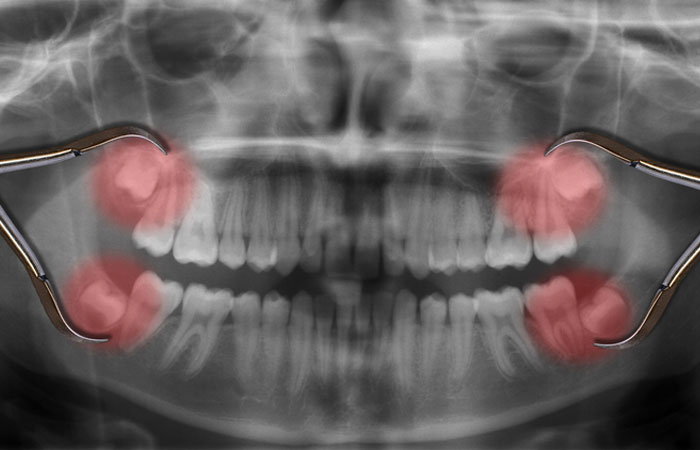
Even though impacted wisdom teeth are not visible in the mouth they can cause a number of problems. Commonly, patients will go to their dentist because of pain in the back of the jaws. Removal of the offending impacted tooth or teeth usually resolves the problem.
The impacted wisdom tooth itself may be the source of the pain or there may be an infection associated it. Bacteria that are always present in the mouth, can work their way down under the gum tissue and cause a painful infection around the crown of the wisdom tooth even though you can’t see the tooth. People often mistake repeated soreness of the gum tissue overlying the wisdom teeth as an effort by the teeth to erupt. Unfortunately this is often a warning sign that trouble is brewing. If this situations goes untreated for an extended period of time (removal of the impacted tooth), the infection may become chronic and lead to destruction of bone around the impacted tooth (a condition known as periodontal disease).
This bone destruction can extend around the other teeth in the back of the mouth and lead to future tooth loss! The same types of bacteria that are responsible for infections can also cause tooth decay or cavities on the roots of the other molar teeth. Just the constant pressure from the impacted wisdom tooth can lead to destruction of the tooth or teeth adjacent to it. Although the overall occurrence of cysts and tumors associated with the jaws is low, when they do occur it is most frequently around an impacted wisdom tooth.
The orthodontist may request that wisdom teeth be removal prior to braces as they may interfere with straightening the other teeth. Finally, an impacted wisdom tooth in the lower jaw occupies space that is usually filled by bone. This creates an inherent area of weakness in the lower jaw which may render it more susceptible to fractures (broken jaw).